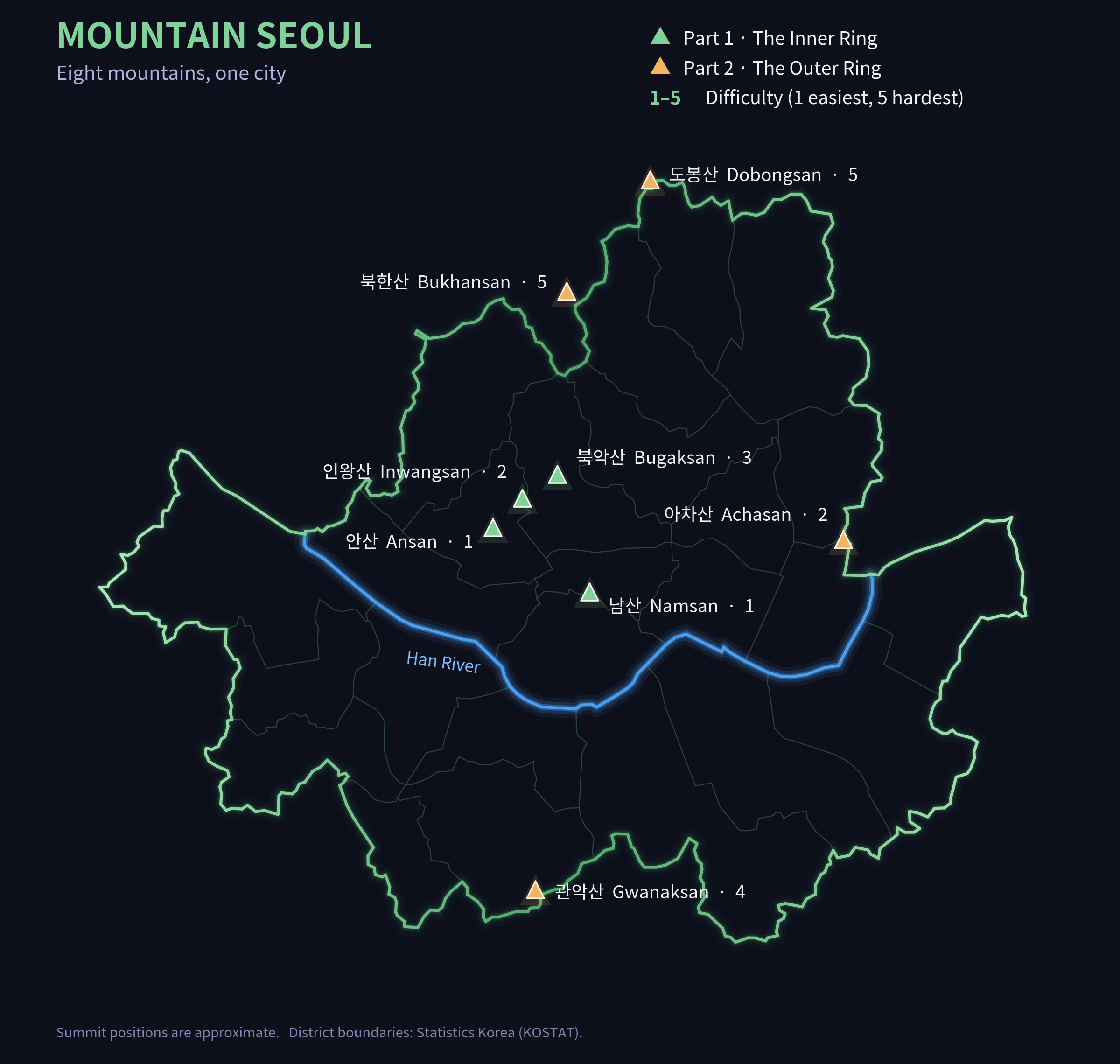
Start with the four city mountains — 남산(Namsan), 인왕산(Inwangsan), 북악산(Bugaksan), and 안산(Ansan), all within about three kilometers of City Hall and each an easy half-day. Save the four bigger outer mountains — 북한산(Bukhansan), 아차산(Achasan), 관악산(Gwanaksan), and 도봉산(Dobongsan) — for a full day and real shoes.
That's the structure of Mountain Seoul: eight mountains you can reach from your hotel, split into two parts, each rated from Level 1 ("a walk with benches") to Level 5 ("a full-day climb with rope sections"). Every mountain has more than one route up, and trail markers are clear even without any Korean.
4 city mountains: the Inner Ring
Four mountains within about three kilometers of City Hall — the book's idea is to walk up from the city.
| Mountain | Height | Level (1–5) | Why go |
|---|---|---|---|
| 남산(Namsan) | 262m | 1 | Top pick. Right downtown, benches all the way up, N Seoul Tower and the city wall on top. |
| 인왕산(Inwangsan) | 338m | 2 | Granite boulders, a shaman shrine, and a view straight down onto the palace and Cheong Wa Dae. |
| 북악산(Bugaksan) | 342m | 3 | Closed for forty years after 1968. Old guard posts, a bullet-scarred pine, and Samcheong-dong below. |
| 안산(Ansan) | 296m | 1 | The easiest summit with the best view: a Joseon beacon on top, Seodaemun Prison at its foot. |
4 outer mountains: the Outer Ring
Bigger mountains on the city's edge that deserve a full day and real shoes — with one gentle exception, 아차산, at Level 2.
| Mountain | Height | Level (1–5) | Why go |
|---|---|---|---|
| 북한산(Bukhansan) | 837m | 5 | Seoul's highest peak, a national park of temples and fortress walls. Start from 진관사(Jingwansa). |
| 아차산(Achasan) | 296m | 2 | A gentle ridge with more viewpoints than any other mountain here, over the Han River and old fortresses. |
| 관악산(Gwanaksan) | 632m | 4 | Harder than it looks: a rocky summit with snack vendors and 연주암(Yeonjuam) hermitage just below. |
| 도봉산(Dobongsan) | 740m | 5 | Dramatic granite peaks and rope sections past 망월사(Mangwolsa). The toughest day in this book. |
Which one should you hike?
- Only time for one: Namsan, the book's top pick — here's the full Namsan guide.
- Easiest summit with a big view: Ansan, 296 meters, Level 1.
- Palace views and history: Inwangsan (Level 2) and Bugaksan (Level 3) — read why Bugaksan was closed for decades.
- Most reward for the least effort in the outer ring: Achasan, Level 2, with more viewpoints than any other mountain in the book.
- A real hiking day: Gwanaksan (Level 4), or Bukhansan and Dobongsan (both Level 5 — Dobongsan is the toughest day in the book).
Mountains with temples on the route
Climb many of these peaks and a temple turns up somewhere on the route: 봉원사(Bongwonsa) on Ansan, Jingwansa on Bukhansan, Mangwolsa on Dobongsan, and Yeonjuam on Gwanaksan. See which 10 Buddhist temples in Seoul are worth visiting for the full list, and the Bongeunsa guide if you'd rather start with a temple that needs no hiking at all.
Two more for next time
Two well-known mountains didn't make the list of eight. 수락산(Suraksan, 638 meters) is a rocky granite mountain on Seoul's northeastern edge, just across the valley from Dobongsan. 청계산(Cheonggyesan) is a forested mountain on Seoul's southern edge, easy to reach from Cheonggyesan-ipgu Station (청계산입구역) on the Shinbundang Line. Much of both lies in Gyeonggi-do, which is part of why they sit outside the book.